
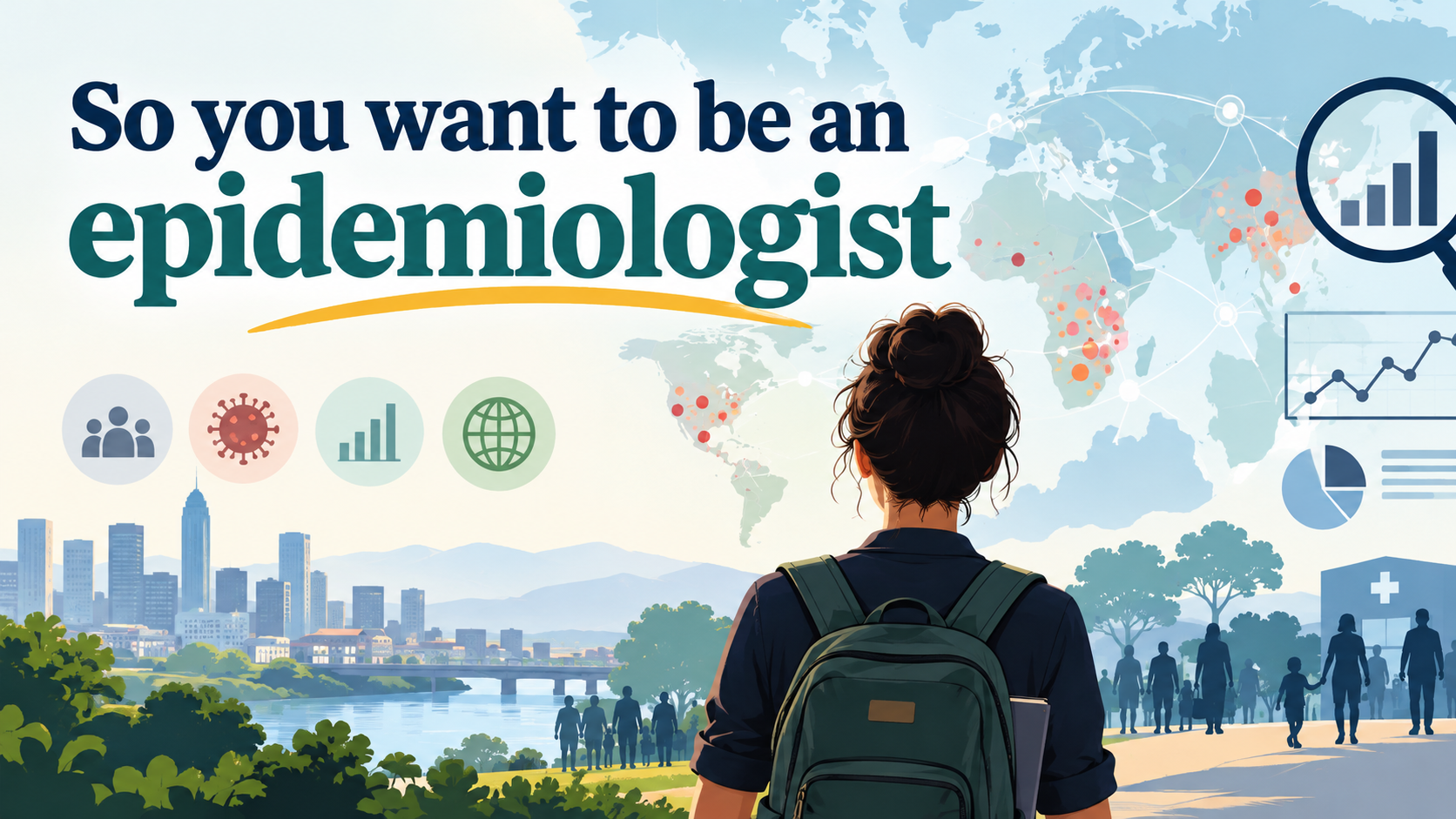
What I’ve learned from advising aspiring epidemiologists and what I would tell someone entering the field today.
Over the years, I’ve had the privilege of talking with students and early-career public health professionals who are trying to figure out how to break into public health and sometimes specifically epidemiology.
The questions are remarkably consistent.
- Where should I look for my first job?
- Should I start in government, a hospital, academia, a nonprofit, or the private sector?
- How do I get experience when every job seems to require experience?
- What skills should I be building now?
- Why can’t I find all these epidemiology jobs everyone says are out there?
And, inevitably…
“Can you look at my résumé?”
Recently, I came across an old email exchange with an aspiring epidemiologist I had advised during the COVID-19 pandemic. Reading the advice I gave her made me think about the many students and young professionals I’ve counseled over the years and about what I would tell someone trying to enter epidemiology today. Some of my advice hasn’t changed. Some of it I would phrase differently. And after years of working across applied epidemiology, research, consulting, workforce development, data science, and now AI, there are a few things I would add.
So, if you’re studying epidemiology, graduating with your MPH, contemplating a career change, or staring at a job board wondering why half the “epidemiology” jobs aren’t actually called epidemiologist, then keep reading.
First: There is No Single Epidemiology Career Path
One of the first things I tell aspiring epidemiologists is this: Stop looking only for jobs called “Epidemiologist.”
You may be eliminating some of the best opportunities available to you simply because the job title doesn’t match the degree printed on your diploma, or the job title you think you should have. I learned this early in governmental public health. The person doing epidemiology may have a title that sounds nothing like an epidemiologist.
- Government Operations Consultant
- Program Specialist.
- Surveillance Coordinator.
- Public Health Analyst.
- Research Specialist.
- Program Consultant.
- Data Analyst.
The title doesn’t tell you very much. You have to read the job description and understand what are they actually asking you to do.
Collect and manage data? Conduct surveillance? Investigate outbreaks? Analyze trends? Work with healthcare providers? Interpret findings? Develop reports? Create visualizations? Evaluate programs? Communicate recommendations? There is your epidemiology job.
Don’t search for a title. Search for the work. I still stand by that advice. I would change one thing I told her though! In my original email communication, I told her that epidemiology at the local level involved case and outbreak investigations and “very little epidemiology” as she had learned during her MPH studies.
Today, I would not say it that way. Not because the work changed, but because my thinking about the work has changed. Local epidemiology is applied epidemiology in its purest form. When the phone rings because several people ate at the same restaurant and are now sick, nobody is waiting for your beautifully specific regression model. You need to figure it out:
- What’s happening?
- Who is getting sick?
- Who is still well?
- What connects them?
- Is anyone else at risk?
- And what are we going to do about it?
You may calculate an attack rate. You may build a line list. You may interview cases. You may call a laboratory, infection preventionist, school nurse, restaurant manager, physician, or another health department. You are collecting imperfect information from multiple sources while the situation is still developing and using it to make decisions. That is epidemiology! And it teaches something that I value even more today: Systems Thinking.
Your First Job Should Build Your Toolbox
The student asked me whether I thought she should start in government or go directly into the private sector. My answer then was basically: it depends.
My answer today? Still: it depends.
Governmental public health can be an incredible training ground. You can be exposed to infectious disease, emergency preparedness, environmental health, laboratories, healthcare systems, communications, community organizations, policy, grants, surveillance systems, and populations you may never have encountered in a classroom. You also learn something graduate school has a hard time teaching: how public health actually works. And, yes, you learn bureaucracy. Lots of bureaucracy.
Healthcare gives you a different view. Hospitals and health systems need epidemiologic thinking in infection prevention, patient safety, quality improvement, antimicrobial stewardship, emergency preparedness, and surveillance. Academia can help you deepen your methodological and research expertise. Nonprofits can expose you to communities, programs, policy, advocacy, implementation, and systems change. Private-sector and consulting work can offer specialization, innovation, and sometimes better compensation. None of those paths is automatically better. Early in your career, I would ask a different question:
What is this job going to teach me?
Please Stop Making Hiring Managers Guess
This may be the piece of advice from that original email that I believe even more strongly today. The student’s résumé included an analysis of asymptomatic COVID-19 cases. Great. But what did she do? Did she clean the data? Analyze it? What methods did she use? What software? Did she create visualizations? Interpret findings? Work with partners? Present results? Write a report? Coordinate meetings? Develop recommendations? Those are the things I want to know.
There is a tendency, particularly among smart people early in their careers, to assume that if they tell me the name of a sophisticated project, I will understand everything they must have done to complete it. Don’t make me do that work. Spell it out. If you cleaned 50,000 records, tell me. If you worked with five partner organizations to obtain data, tell me. If you used R, SAS, Python, SQL, Tableau, Power BI, ArcGIS, or Excel, tell me. If your analysis changed a recommendation, tell me. Your résumé isn’t the place to be mysterious.
Academic Experience Is Experience. Another thing I saw in her résumé was something I continue to see with students today. They say: “I don’t really have experience yet.” Then they proceed to tell me about the dataset they cleaned, the literature review they conducted, the statistical analysis they completed, the dashboard they created, the community assessment they participated in, the poster they presented, and the manuscript they helped write. That’s experience! Your practicum is experience. Your graduate research is experience. Your capstone is experience. Your assistantship is experience. Your manuscript is experience. Your job is to translate that academic experience into the language of the workplace.
Put the Manuscript on Your CV. She also asked whether she could include manuscripts that had not yet been published. Absolutely! Just tell the truth about their status. Submitted, under review, accepted-in press, in preparation. Those words mean different things. Use them accurately. Early-career professionals sometimes leave valuable accomplishments off their CVs because they think they don’t “count” yet. They count. Just represent them honestly.
Don’t Overlook Fellowships. I also encouraged her to look at fellowships. A good fellowship can give a new epidemiologist something that is difficult to manufacture on your own: structured experience + mentorship + professional network + credibility. That combination can accelerate a career. But I would tell today’s student not to become overly fixated on one prestigious program or organization. Look broadly. Your goal isn’t simply to collect a recognizable name on your résumé. Your goal is to get into rooms where you can learn, contribute, meet people, and become known for doing good work.
Learn More Than Statistics. If you asked me what skills an aspiring epidemiologist should develop today, statistical analysis would certainly be on my list. But it would not be the whole list. Learn to clean ugly data. Learn to visualize data. Learn to explain a finding without using epidemiologic jargon. Learn to write. Learn to present. Learn to facilitate a meeting. Learn how surveillance systems work. Learn how organizations make decisions. Learn to ask good questions. Learn how to collaborate with people who know things you don’t. And now, yes, learn how to work with AI. Not how to copy and paste a question into an AI tool and accept whatever comes back. Learn how to use AI to accelerate your thinking while retaining your responsibility for the thinking. The tools will change. The critical thinking will not.
Don’t Reject Yourself
The young epidemiologist who wrote to me said something else that stuck with me. She eventually wanted to work in a hospital, but she wasn’t applying to hospital positions because she assumed she didn’t have enough experience. I see versions of this all the time. Read the qualifications. Be realistic. But do not reject yourself before the employer gets the opportunity to consider you. You do not need to know everything on your first day. You need enough foundation to contribute, enough curiosity to learn, and enough humility to know the difference between what you know and what you don’t. Apply. Let them decide.
Your Epidemiology Degree May Take You Somewhere You Never Expected
This is probably the biggest thing I would add to that old email today. Your career may not look anything like the career you imagined when you chose epidemiology. Mine certainly hasn’t. The value of epidemiology isn’t limited to knowing how to calculate an odds ratio, conduct an outbreak investigation, or build a surveillance system. Epidemiology teaches you a way of thinking.
- What is happening?
- Who is affected?
- What patterns do I see?
- What information is missing?
- What might explain what I’m seeing?
- How confident am I in the evidence?
- What should we do next?
Those questions travel remarkably well. Across infectious disease. Across healthcare. Across research. Across evaluation. Across consulting. Across leadership. Across data science. And, increasingly, across AI. So if you’re graduating with an epidemiology degree and wondering where you’re supposed to go next, here’s my advice: Don’t worry so much about finding the perfect epidemiology job. Find a place where you can solve real problems. Find people you can learn from. Build your toolbox. Learn the system. Do good work. Ask good questions.
And don’t become so attached to the career path you planned that you miss the one unfolding in front of you. Because sometimes the most interesting epidemiology career is the one you never knew existed.
That’s the world according to Dr. Sarah.
