

How Do We Prepare the Public Health Workforce for the Future?
AI is changing public health. But as we continue to think about what that means for our field, we keep coming back to a question that is bigger than the technology itself:
If the way we do our work is changing, what does the public health workforce need to become?
This October, Health Communications Consultants, Inc. (HCC, Inc.) will be exploring that question with colleagues at the AIxPH 2026 Conference during our roundtable, From Technical Expert to Adaptive Systems Leader: Preparing the Future Public Health Workforce in the Age of AI.
At HCC, Inc., we have been thinking about what it will take to prepare the workforce not just for AI, but for the increasingly complex and connected environments in which public health professionals are being asked to work.
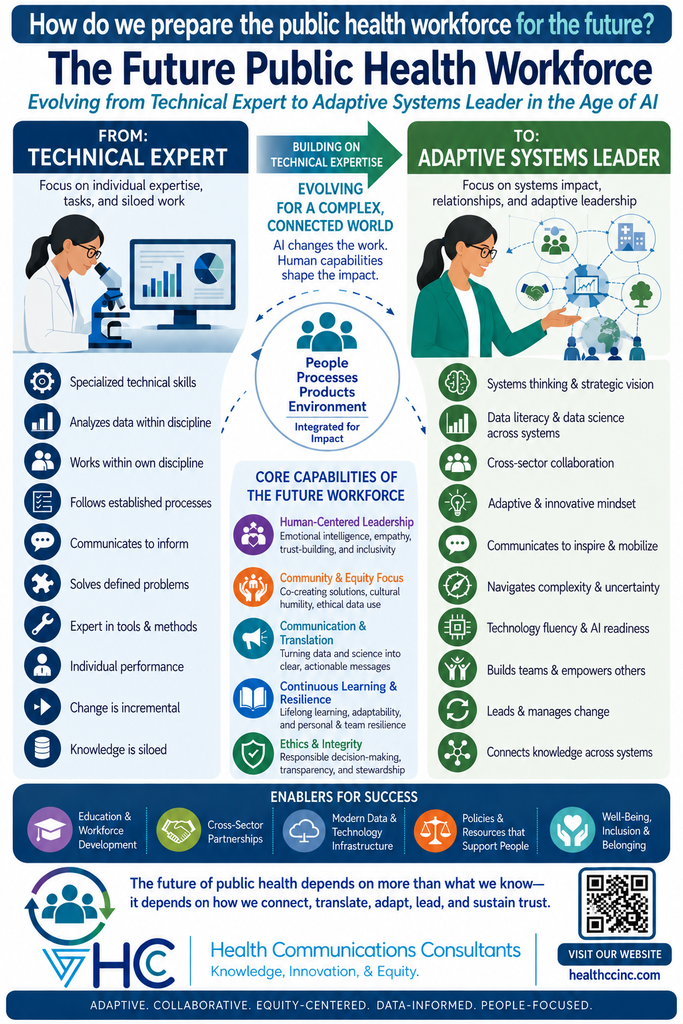
The infographic below represents where our thinking is today.
 Download the Infographic
The Future Public Health Workforce: Evolving from Technical Expert toward Adaptive Systems Leader in the Age of AI
Attending our AIxPH roundtable? Download a copy to follow along with the discussion and bring it back home to continue the conversation within your organization.
 Building on Technical Expertise
We want to be clear about something that is important to this model:
Technical expertise still matters.
We are not suggesting that public health professionals need to move away from being epidemiologists, laboratorians, data scientists, health educators, preparedness professionals, infection preventionists, communicators, or other technical experts.
We need that expertise.
What we are asking is whether technical expertise alone will be enough for the environments in which we increasingly find ourselves working.
AI can already support tasks involving analysis, synthesis, drafting, visualization, communication, and decision support. As those capabilities continue to develop, we believe we need to think intentionally about the capabilities public health professionals will need in addition to their technical expertise.
That is the idea behind what we are calling the Adaptive Systems Leader.
And by leader, we don’t mean that everyone needs a formal leadership position.
We mean professionals who can connect knowledge across systems, navigate complexity and uncertainty, communicate and mobilize people, collaborate across sectors, lead and adapt to change, and use technology, including AI, effectively.
Technical Expert → Adaptive Systems Leader
We are purposefully building upon expertise not replacing it.
 AI Changes the Work. Human Capabilities Shape the Impact.
At the center of our infographic are four interconnected elements:
 PEOPLE •
 PROCESSES •
 PRODUCTS •
 ENVIRONMENT
AI doesn’t enter an empty system. It enters organizations made up of all four and it has the potential to change all four.
That means preparing the future workforce cannot simply be about teaching people how to use AI tools.
We also need to think about:
- Human-Centered Leadership
- Community & Equity Focus
- Communication & Translation
- Continuous Learning & Resilience
- Ethics & Integrity
And those capabilities need to exist alongside systems thinking, collaboration, judgment, technology fluency, change leadership, and the ability to navigate uncertainty.
 Our working hypothesis:
These human and adaptive capabilities become more important as technology becomes more capable.
But it is a hypothesis.
This infographic is not intended to be the answer. It is an evidence-based starting point for a conversation.
 So, How Do We Prepare the Workforce?
That is what we want to explore with participants at AIxPH.
Our roundtable will center on three questions:
1️⃣ What is changing?
What public health work will AI substantially change over the next five years?
2️⃣ What capabilities become more valuable?
What will public health professionals need to navigate an increasingly AI-influenced environment?
3️⃣ What do we need to change now?
How do we actually prepare the workforce to develop those capabilities?
These questions are at the heart of the roundtable because we believe the people doing this work should help shape what comes next.
 This Conversation Will Continue
After AIxPH 2026, we will return to this post and share what we learned from the roundtable including where participants agreed with the model, where they challenged it, what they believe is missing, and their ideas for preparing the workforce.
 Joining us at AIxPH?
Bring your experience, questions, ideas, and challenges to this model.
We want to hear them. Sarah will be at Table 15 waiting for you!
And if you found your way here through the QR code at our roundtable, thank you for being part of the conversation. Download the infographic above, share it with your colleagues, and continue thinking with us about one central question:
 How do we prepare the public health workforce for the future?
